As expectations around digital accessibility continue to grow, colleges and universities are taking a closer look at how well their resources support access for everyone. In the United States, upcoming ADA Title II requirements for public institutions—taking effect in April 2026—have accelerated those conversations, and we’ve heard directly from librarians and institutional leaders assessing what this means for the platforms and vendors they rely on. At the same time, accessibility is increasingly a global focus, with similar requirements already in place—or taking shape—in other regions.
At JSTOR, we want to be clear and reassuring: this work is not new for us, and it’s not something we’re approaching as a one-time deadline. Accessibility has long been part of how we think about quality, long-term access, and usability—and the steps we’re taking build on that foundation as part of a broader, shared responsibility across the scholarly ecosystem.
A collection built across generations
JSTOR’s strength has always been the depth and breadth of our collection. This also brings complexity. Our platform includes newly published material alongside scholarship created decades ago, much of it originally designed for print, and digitized long before today’s accessibility standards existed.
With the immense scale of older collections to address, many scholarly platforms are taking a phased approach to accessibility—prioritizing new or highly used materials first, and working through older content over time. Fully remediating an entire backfile can be costly and time-intensive, and doing so upfront can delay the more important goal of meeting a user’s need in the moment.
At JSTOR, our goal is simple: no matter which item someone needs—whether it’s new, old, or rarely used—they should be able to access, read, and use it when they need it. That principle is what led us to invest in on-demand remediation alongside retaining existing human interventions, and broader, ongoing accessibility improvements across the platform.
Ensuring access at the moment it’s needed
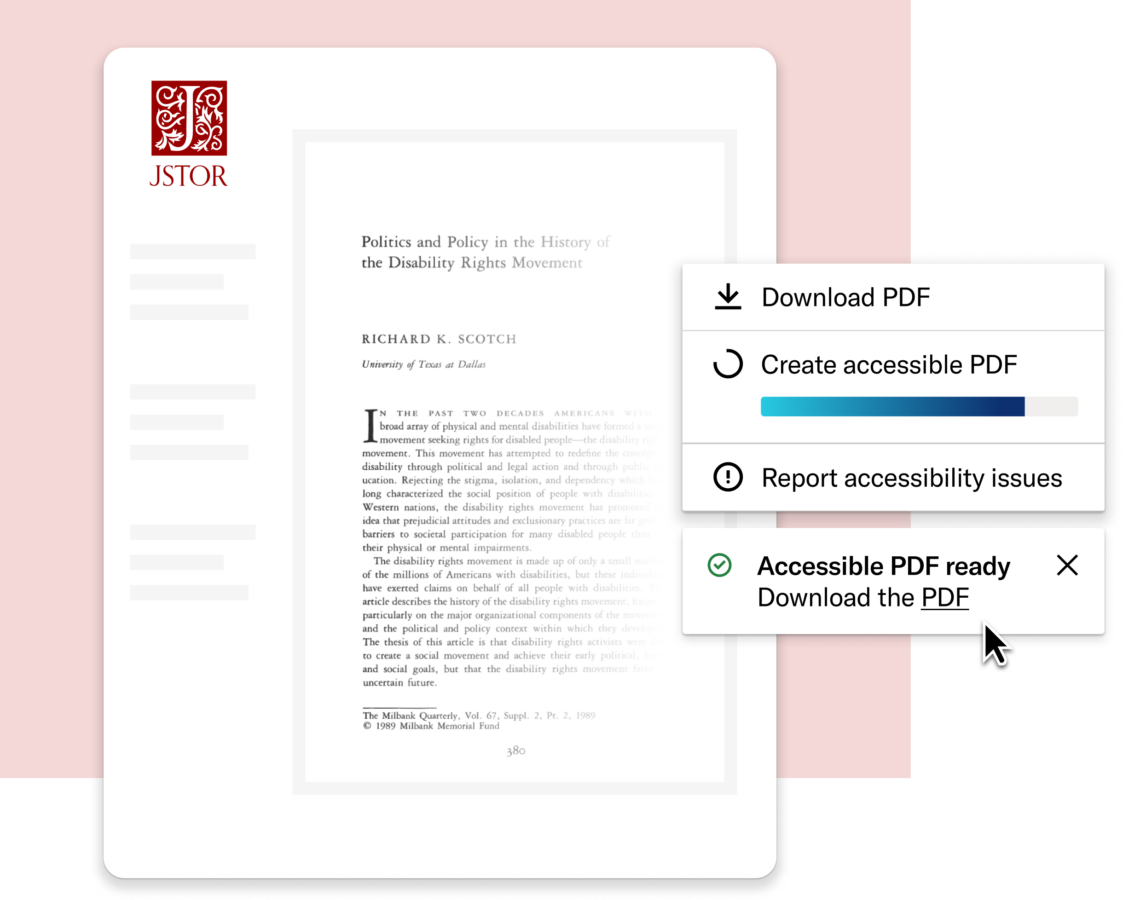
To support that goal, we’re introducing new on-demand remediation capabilities ahead of April. These tools are designed to ensure that when a user encounters content that isn’t yet fully accessible, they can request a more accessible version and, in most cases, receive it within minutes instead of days, with timing varying based on the length, complexity, and source of the material.
From a user’s perspective, this means:
- Access isn’t limited to a subset of the collection
- Older materials aren’t left behind
- Accessibility support is available when it’s actually needed, not just where remediation has already occurred
This approach allows us to provide consistent access across the full corpus while continuing to improve accessibility more broadly over time.
Built on experience and designed to evolve
JSTOR has a long history of meeting accessibility standards, and this work reflects a continuation of that commitment rather than a change in direction. The tools we’re introducing are designed to scale, improve, and adapt as standards evolve, and as we learn more about how people use the platform.
Accessibility isn’t static—and neither is our approach. We’ll continue refining our processes, working with partners, and investing in improvements that make scholarly content more usable in practice.
What comes next
The on-demand remediation capabilities described here are on track to be available by April 2026. We’ll continue sharing updates as this work progresses, including more detailed information about how the system works behind the scenes.
If you’d like to learn more about our broader approach to accessibility—including standards, documentation, and support resources—we invite you to explore our new accessibility page.